
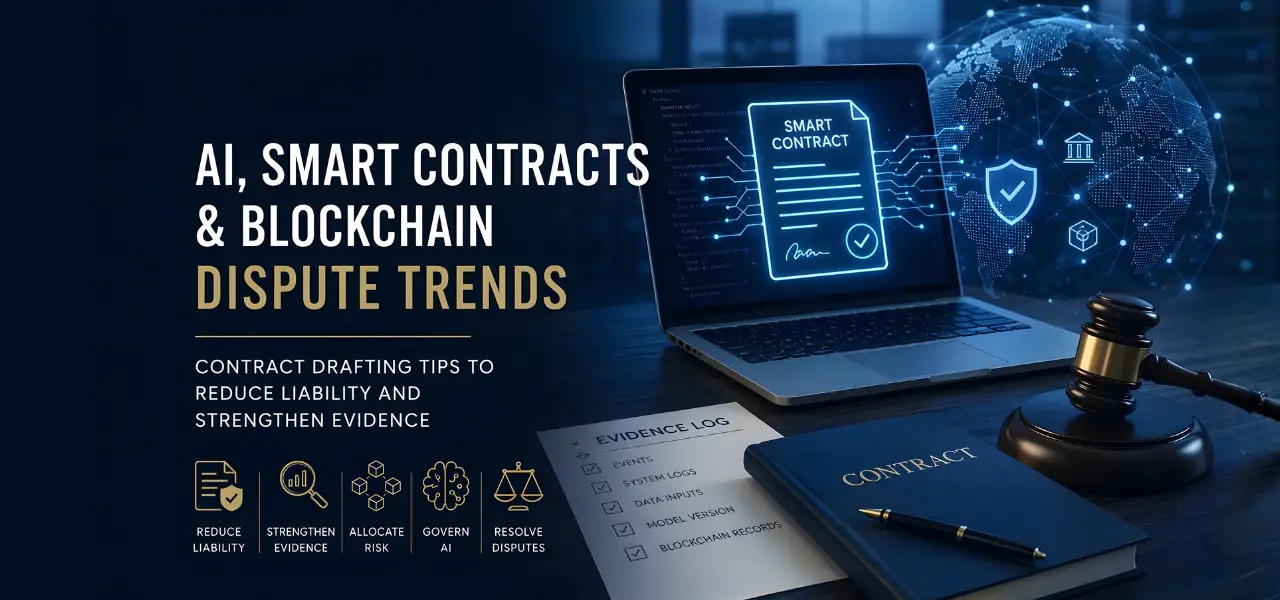
Artificial intelligence, smart contracts, & blockchain based workflows are reshaping how businesses negotiate, perform, & evidence commercial agreements. For legal teams, the challenge is no longer simply understanding the technology. It is anticipating how automated systems fail, how liability is divided across multiple parties, & how disputes can be proved when performance is driven by code, system logs, external data feeds, & digital records.
The EU AI Act adds further pressure by requiring more careful attention to compliance, oversight, transparency, & supply chain responsibility. This article explores the dispute trends now emerging in practice & outlines drafting approaches that can reduce both legal & commercial risk.
Why AI & Blockchain Contracts Are Creating a New Disputes Landscape
AI systems, smart contracts, & blockchain based contracting are increasingly used in technology, fintech, supply chain, & platform transactions because they offer speed, automation, & stronger audit trails than traditional paper heavy processes. But the same features that make these tools attractive can also make disputes sharper. An algorithm may generate an incorrect result, a self executing clause may trigger at the wrong moment, or an on chain record may capture an outcome that does not reflect the parties’ actual commercial intention.
The central issue is still contractual. Many businesses introduce automated decision making & code led performance without updating the legal agreement to deal with risk allocation, interpretation, escalation rights, remediation, & evidential access.
That gap matters even more under the EU AI Act, where obligations may fall on providers, deployers, importers, & distributors, each of whom may need tailored compliance, cooperation, & indemnity wording. The key legal question is not whether a contract is labelled “smart,” but whether it remains enforceable under ordinary rules of formation, interpretation, remedies, & jurisdiction once performance becomes automated.
For that reason, dispute planning now needs to address how automated processes are controlled, how failures are recorded, & how enforcement will work when code plays a central role in performance.
The Main Legal Risks Emerging in AI Enabled & Smart Contracts
AI enabled contracts create risk when system outputs are inaccurate, unstable, or difficult to explain. Hallucinations, model drift, bias, & automated decision errors can disrupt operations, distort pricing, affect credit or eligibility decisions, & trigger customer complaints or regulatory scrutiny.
Where a system is used in a higher risk context, governance failures may become contractual issues as well as compliance issues, particularly if one party promised oversight, monitoring, documentation, or human review and failed to deliver it.
Smart contracts introduce a different but related set of risks. Coding flaws, oracle failures, poor configuration, or incorrect parameters can cause unintended execution, while on chain transactions may be difficult or impossible to reverse after deployment. Liability can also become fragmented across developers, providers, deployers, platform operators, integrators, resellers, & end users.
Unless the agreement clearly allocates responsibility for data quality, model configuration, monitoring, compliance, intervention, & remediation, each party may argue that another controlled the point of failure. Another recurring issue arises where code & legal drafting do not align: parties must decide in advance whether the natural language contract, the execution logic, or a defined hierarchy will prevail if they conflict. Cross border operation adds further complexity, especially where users, nodes, assets, & service providers are spread across multiple jurisdictions.
Evidence Enforcement & Dispute Strategy in Digital Contracting
Disputes involving digital contracting often turn on evidence that is technical, decentralised, & highly time sensitive. Ordinary document review is rarely enough. Blockchain records may improve traceability, but a court or tribunal will still ask whether a ledger entry is authentic, relevant, complete, & properly connected to the issue in dispute. AI generated outputs can also help or hinder proof. If prompts, training assumptions, logs, model versions, or access records are missing, incomplete, or proprietary, it may be difficult to establish what happened, why it happened, & who controlled the relevant stage of decision making.
Causation is often especially difficult. Harm may result from defective model logic, poor input data, flawed human instructions, an external data feed, or later operational choices made after the system produced its output. In practice, parties may need urgent remedies before loss becomes irreversible, particularly if a smart contract has already triggered payment, transfer, or release of digital assets.
For cross border disputes, arbitration is often attractive because it offers confidentiality, procedural flexibility, & potential access to decision makers with technical expertise. Court proceedings, however, may still be preferable where urgent injunctive relief, third party disclosure, or public enforcement powers are needed. The best dispute strategy usually starts at the drafting stage, by deciding what records must be kept, who can inspect them, & how quickly intervention can occur if automated execution goes wrong.
Contract Drafting Tips to Reduce AI & Smart Contract Risk
Effective drafting starts with precise definition. The contract should identify the relevant model or system, its intended use, key dependencies, data sources, version, update process, & whether it is static or continuously learning. That level of detail reduces later arguments about what the supplier or operator actually promised, especially where performance depends on external APIs, cloud infrastructure, or chain specific services.
Contracts should also allocate responsibility for inputs, outputs, monitoring, validation, & human oversight. If one party must supply clean data, another must review outputs, & a third controls deployment settings, the agreement should say so explicitly.
Clauses dealing with algorithmic failure should go beyond generic warranty language. They should address performance thresholds, known limitations, testing standards, incident response, notice periods, correction obligations, service levels, & remedies for materially unsafe or incorrect outputs.
For smart contract arrangements, the agreement should specify whether code or natural language terms govern in the event of inconsistency, require testing & acceptance before go live, & reserve pause, override, upgrade, or termination rights where automated execution could magnify loss.
An effective evidence framework should also require logging, retention, audit access, forensic cooperation, & preservation duties. Finally, dispute clauses should be adapted to the technology, with consideration given to expert determination for technical questions, arbitration for cross border matters, governing law certainty, & emergency relief where self executing processes could cause immediate harm.
A Practical Model Clause Pack for Tech & Fintech Clients
A practical clause pack for tech & fintech transactions should convert abstract legal risk into clear operational controls. An AI use & compliance clause can limit deployment to approved purposes, prohibit unauthorised retraining or secondary use of data, & allocate responsibility for risk classification, transparency, documentation, oversight, & regulatory cooperation.
A liability & indemnity clause should then address algorithmic errors, data quality failures, third party intellectual property or privacy claims, service disruption, & regulatory breaches, while preserving agreed caps, carve outs, & any shared responsibility structure where both parties influence inputs or configuration.
For blockchain based workflows, a smart contract precedence clause should establish whether code, natural language drafting, or a stated hierarchy governs if the two diverge. An audit, logging, & evidence preservation clause should require access to system records, retention periods, cooperation in investigations, & preservation of relevant metadata.
A suspension, manual override, & incident management clause should allow immediate intervention where execution becomes unlawful, unsafe, or materially defective. The clause pack should then be tailored to the transaction type, because SaaS deals, licensing arrangements, payments, digital trading, procurement, & supply chain automation each create different operational dependencies, regulatory exposures, & dispute risks.
What Businesses Should Do Now
Businesses should review existing templates now rather than waiting for a dispute to expose the gaps. Contracts should be tested against automation related failure scenarios, including inaccurate outputs, model drift, undocumented updates, broken integrations, oracle failures, & unauthorised changes to deployment settings.
They should also deal expressly with liability allocation, audit rights, monitoring obligations, evidential preservation, & intervention rights so that prompts, logs, model versions, blockchain records, & related technical artefacts are retained in a dispute ready form.
Priority should be given to higher risk deployments in fintech, payments, trading, supply chain operations, & platform agreements, where losses can escalate quickly & cross border enforcement issues are more likely. Because these risks sit across legal, compliance, procurement, product, operations, & IT functions, contract drafting alone is not enough.
Organisations need coordinated review so that governance, controls, technical processes, & incident response all align with the legal position. Early legal intervention is usually far less costly than post dispute remediation, particularly where an automated process can continue acting at scale once something has gone wrong.
Conclusion
AI enabled contracting & blockchain automation can deliver speed, consistency, & operational efficiency, but they also create new fault lines in commercial relationships. Disputes are increasingly shaped by inaccurate outputs, coding defects, data quality failures, fragmented responsibility, & disagreement over whether code or natural language terms should control.
Businesses that update their contracts now will be better placed to reduce enforcement risk, improve evidential certainty, & respond quickly if systems fail. Legal teams, procurement functions, & technology stakeholders should review current templates against both regulatory expectations & real operational risks before deploying AI or smart contract solutions in significant transactions. Where the technology is central to performance, specialist legal drafting is no longer optional.
Sources
- EUR Lex Regulation (EU) 2024/1689 (AI Act)
- Law Commission of England and Wales Smart contracts
- NIST AI Risk Management Framework
- UNCITRAL Convention on the Recognition and Enforcement of Foreign Arbitral Awards (New York, 1958)
- UK Jurisdiction Taskforce Legal Statement on Cryptoassets and Smart Contracts
